Off-Page SEO Checklist for Small Businesses
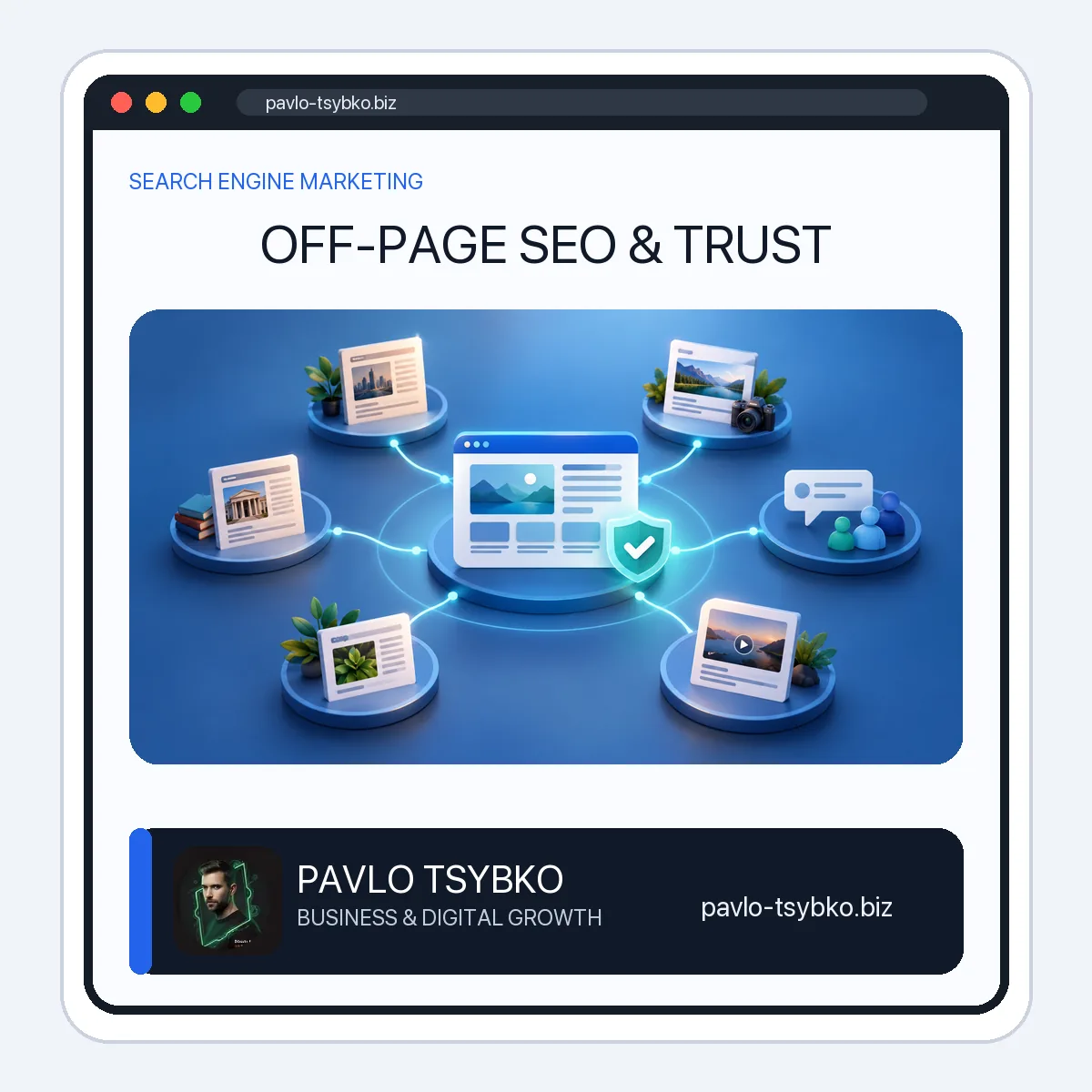
Off-page SEO is the work that helps other people discover, evaluate, mention, and recommend your business beyond your own website. It is not a contest to collect the most backlinks. For a small business, a sensible plan starts with accurate business information, useful evidence worth citing, relevant relationships, and a way to measure what those activities actually bring.
This off-page SEO checklist separates durable reputation work from shortcuts that can waste money or violate search policies. Use it alongside a technically sound website and helpful pages; outside mentions cannot compensate for an unclear offer or a poor customer experience.
What counts as off-page SEO?
Off-page SEO covers signals and discovery paths outside the pages you control: editorial references, relevant links, business profiles, customer reviews, community participation, and brand mentions. They do not all work as ranking factors in the same way. A review can influence a customer’s decision even when it is not a direct ranking lever; a relevant publisher mention can send referral traffic even if the link carries no ranking credit.
Keep the distinction clear: the business goal is qualified visibility and trust, not a particular number of links. For the on-site side of the work, start with the keyword research and page-mapping guide so outreach has a genuinely useful destination.
The practical off-page SEO checklist
1. Make your business identity consistent
Check the name, location or service area, contact information, hours, and primary website URL wherever customers already find you. Fix outdated details on profiles you actually own. If you serve local customers, maintain the relevant business profile and a small number of accurate, industry- or location-specific citations. Do not submit to hundreds of unrelated directories just to manufacture links.
For each profile, record its owner, login recovery method, public URL, and last review date. This prevents an old phone number or abandoned listing from becoming the first impression a prospect sees.
2. Publish something another site would cite voluntarily
A useful resource gives a relevant editor a reason to reference you. Examples include a clearly dated local market explainer, an original comparison with a transparent method, a practical checklist, or a case study with permission to share results. Label estimates as estimates and explain what you measured. A generic sales page rarely earns the same kind of reference.
Before promotion, ask whether a reader who never buys from you would still find the resource useful. Google’s people-first content guidance emphasizes clear authorship, evidence, and a satisfying answer, not content produced only to attract search traffic.
3. Reach out where the audience is relevant
Make a short list of publications, professional associations, partners, and communities whose audiences overlap with yours. Read their editorial rules first. When you have a resource that fills a real gap, send a specific note explaining why their readers might benefit. A mention or collaboration is valuable only if it makes sense without the promise of a search ranking boost.
For guest contributions, contribute expertise and disclose commercial relationships. Do not distribute near-identical articles with keyword-heavy anchor text across many sites. Google identifies links created primarily to manipulate rankings, including certain paid articles, optimized guest-post anchors, and low-quality directory links, as link spam.
4. Treat reviews as customer feedback, not a link tactic
Invite real customers to describe their experience where reviews are relevant to your business. Make the request neutral, follow each platform’s rules, and never buy or fabricate reviews. Respond to criticism with a useful resolution rather than arguing in public. Look for recurring complaints: they often point to a product, support, or expectation problem that needs fixing on the site too.
5. Participate in communities without dropping links everywhere
Answer questions you can genuinely help with, identify your connection to the business when relevant, and link to your own page only when it adds necessary detail. The immediate outcome may be a qualified conversation, not an SEO metric. A relevant discussion that brings the right visitor is better than dozens of low-value promotional comments.
6. Reclaim legitimate mentions and fix broken references
Search for your brand and for resources you have published. When a publication already mentions your work but points to a broken or outdated URL, politely provide the current address. Likewise, if you have moved an article, use a permanent redirect and update important internal links. Do not pressure independent editors to add or change links solely for a preferred anchor phrase.
What to avoid
- Buying links that pass ranking credit. A paid placement may be legitimate advertising, but it should be clearly disclosed and qualified appropriately, not sold as an artificial ranking signal.
- Mass directory submissions. Most generic directories do not provide a useful audience and can leave inconsistent business data behind.
- Promised “domain authority” gains. A third-party score can be a research aid; it is not a Google ranking guarantee.
- Copy-paste guest posts and reciprocal-link networks. If the main reason a page exists is to exchange ranking credit, reconsider the tactic.
- Fake reviews or undisclosed endorsements. The trust damage can outlast any temporary visibility.
A 30-day plan for a small team
- Week 1 — baseline: list important profiles, mentions, referring pages, referral visits, branded queries, and review themes. Note what is already working.
- Week 2 — repair: correct business details, replace broken destination pages, and clarify any weak landing page that outreach would send visitors to.
- Week 3 — create: publish one evidence-backed resource with a clear author, date, method, and useful takeaway.
- Week 4 — distribute: contact a small set of relevant editors or partners with a tailored reason to read it; answer related community questions without spamming.
Repeat what leads to useful visits, inquiries, or credible references. Stop activities that produce only a large spreadsheet of irrelevant links.
How to measure progress without overclaiming
Track outcomes at two levels. First, record what you can verify directly: accurate profiles, published mentions, working referring URLs, relevant referral sessions, review response time, and inquiries attributed to those sources. Second, watch search performance over time in Google Search Console, including branded and non-branded queries. A single ranking change is not proof that one new link caused it; site updates, competition, seasonality, and search-system changes can all matter.
Review each referring page for relevance and real readership rather than relying only on a third-party authority metric. Keep a simple log of outreach date, contact, resource offered, editorial response, and eventual traffic or leads. That makes the work repeatable and helps you avoid paying for appearances that bring no value.
Frequently asked questions
Do small businesses need backlinks?
Relevant editorial links can help people discover a business and can help search engines discover pages. The useful question is not how many links to buy, but whether your business has information and relationships that deserve genuine references.
Are all directory listings harmful?
No. A legitimate local, professional, or industry directory can help customers find you. The risk is treating unrelated bulk submissions as an SEO shortcut instead of maintaining a few accurate, useful profiles.
How soon will off-page SEO work?
There is no reliable fixed timetable or guaranteed ranking outcome. Profile corrections can help customers immediately; editorial mentions and search visibility may take longer and depend on many factors. Measure useful traffic and business inquiries as well as search data.
Next step
Choose one service or resource you want the right audience to discover. Check that its page answers the reader’s question, then complete the first two weeks of the checklist before launching outreach. If you want an outside review, contact Pavlo Tsybko with the page, target audience, and the off-page activities you have already tried; the review should focus on practical opportunities and risks, not promised rankings.