How to Promote a Small Business Online: Compare 4 Channels
Promoting a small business yourself can be sensible when you know what you want to learn, have time to run a small experiment, and can measure whether it produces useful inquiries. But “free promotion” is rarely free: it uses the owner’s time, and paid channels need a budget as well. The right first channel depends on how customers discover your offer, how soon you need demand, and whether you can keep the work going.
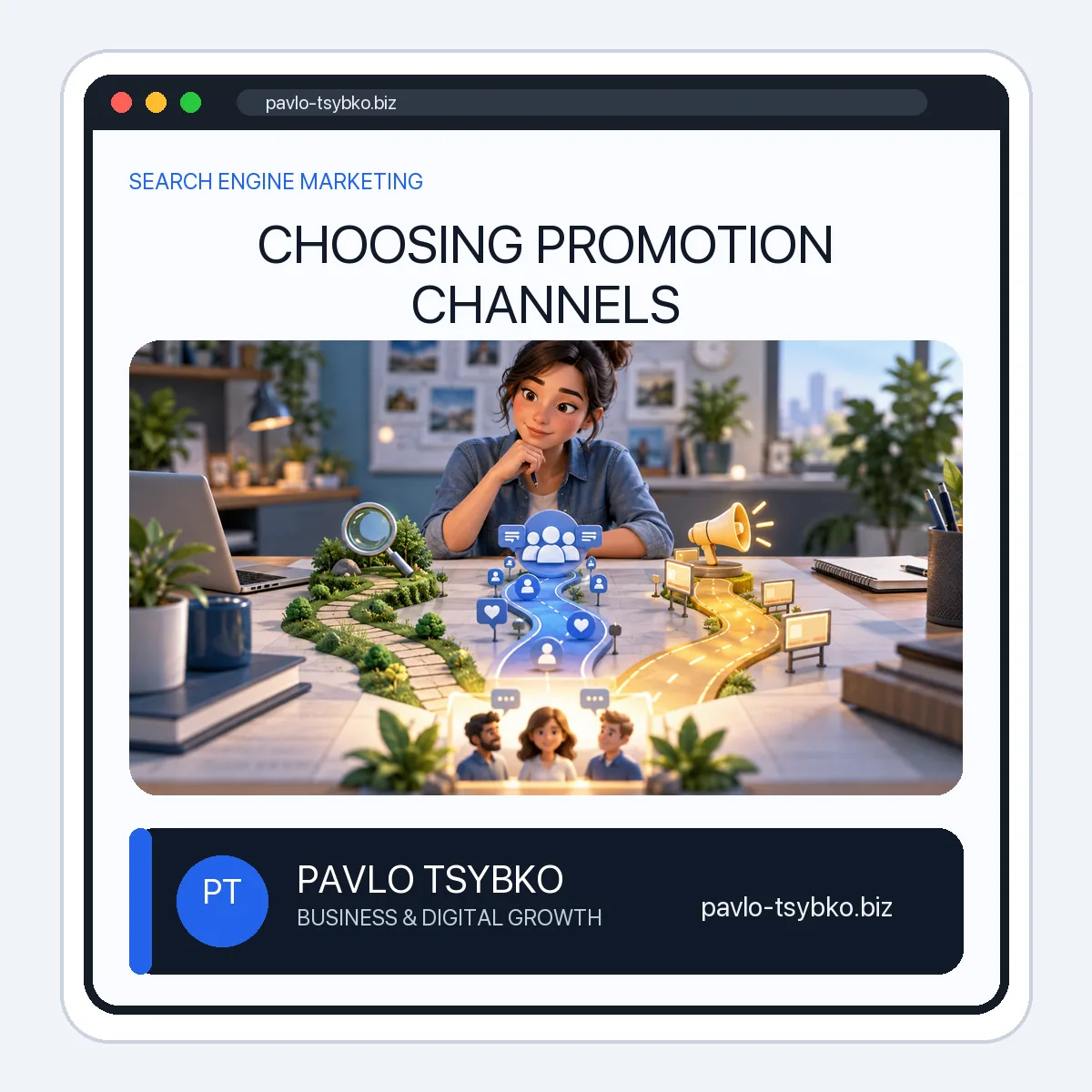
This guide compares four common choices—organic search, social media, content marketing, and paid advertising—without promising a universal winner. It is a decision framework, not four more step-by-step tutorials. If you already know your preferred channel, follow the focused guides linked below.
First, define the customer action you need
Before choosing a platform, write down one specific outcome: qualified calls, booked consultations, product inquiries, trial sign-ups, or repeat purchases. Then ask where a customer is likely to be immediately before that action. Someone searching for a nearby service has a different intent from someone browsing a social feed. A content article can help explain a complex purchase, but it may not be the fastest way to fill an empty booking calendar this week.
Check that the destination works. Your service page should say what you offer, to whom, where it is available, what it costs or how pricing is determined, and how to contact you. Test the form or booking flow on a phone. Sending more visitors to a confusing page is not a marketing strategy.
Compare the channels by trade-off, not by hype
| Channel | Good first use | Main commitment | Watch for |
|---|---|---|---|
| Organic search (SEO) | Answer an existing customer question or make a service page easier to find. | Useful pages, technical upkeep, and patience. | Ranking uncertainty; traffic that does not turn into inquiries. |
| Social media | Show work, build a community, or maintain a visible relationship with buyers. | Regular participation and direct responses. | Platform dependence and activity with no business outcome. |
| Content marketing | Explain a considered purchase, teach a topic, or answer recurring objections. | Research, original examples, distribution, and updating. | Publishing volume without a distribution or conversion path. |
| Paid advertising | Test an offer or reach a defined audience while the campaign is funded. | Media spend, tracking, creative, and ongoing optimization. | Paying for irrelevant clicks or measuring clicks instead of customers. |
These are qualitative trade-offs, not fixed timelines or return-on-investment estimates. The same channel can perform very differently for an emergency plumber, a B2B consultant, and a niche online store. Start with the customer journey and your capacity to maintain the channel.
Organic search: useful when demand already exists
Search can work when people already describe the problem you solve. Start with one important service or question and make the corresponding page genuinely useful. Check that search engines can access it and that a visitor can understand the next step. Google’s SEO Starter Guide is clear that there is no secret action that guarantees first place.
The advantage is that a useful page can keep serving customers after publication. The limitation is uncertainty: search visibility takes work, competitors change, and a ranking is not a sale. Do not buy a package of guaranteed positions. For a workable sequence, use the DIY SEO guide; for identifying distinct customer questions, use the keyword research guide.
Social media: useful when interaction is part of the purchase
A social channel can let customers see your work, ask questions, and learn how you think. That is particularly useful when trust, taste, a demonstration, or a continuing relationship matters. Choose a platform your buyers actually use and that you can maintain; an abandoned profile is not a growth asset.
The cost is ongoing attention. Organic reach and platform formats can change, and likes do not necessarily lead to inquiries. Set a response process, keep a link to a relevant destination, and record meaningful conversations or leads rather than posting frequency alone. Our separate social-media promotion plan covers account setup, content, interaction, and advertising in more detail.
Content marketing: useful when customers need an explanation
Articles, examples, comparisons, and practical resources can help a buyer evaluate a complex offer. The useful question is not “How many posts can we publish?” but “What does a customer need to understand before they trust this decision?” Original experience, examples, limitations, and a clear next step matter more than bulk text. Google’s people-first content guidance also warns against producing pages mainly to capture search visits.
Content needs distribution and maintenance. One article can support search, email, social sharing, and a sales conversation, but it still needs a reader path and an owner who will update outdated details. For the planning workflow, see our content marketing strategy and content checklist.
Paid advertising: useful for a controlled test, not a rescue plan
Paid search or social ads can put an offer in front of an audience while you fund the campaign. That can be useful for testing a clear offer or capturing demand that already exists. But the landing page, conversion tracking, audience selection, and follow-up process must be ready before money is spent. Start with a spend amount you can afford to learn from and a clear stop or review rule.
Do not confuse an average daily budget with an absolute daily ceiling. Google Ads explains that some campaigns may spend up to twice the average daily budget on a particular day while remaining within a monthly charging limit; check the actual settings for your campaign in Google’s spend guidance. Our separate advertising plan is the place for execution detail, but review its age and current platform settings before acting on it.
A practical way to choose your first experiment
- Pick one customer segment and one offer. Avoid testing multiple audiences and messages at once.
- Choose one primary channel. If buyers actively search for the service, improve the relevant search destination. If they need to see your work and talk with you, test a social/community format. If they need education, publish one useful resource and plan its distribution. If you need a time-bound test and have a viable budget, consider paid ads.
- Write down the starting point. Record the current relevant traffic, inquiries, conversion problems, and time or spend invested. Use the same definitions later.
- Run a bounded test. Set a review date and a minimum amount of effort you can sustain. Keep notes on what changed so you do not mistake seasonality or a website fix for a channel effect.
- Judge qualified outcomes. A smaller number of relevant inquiries can matter more than many visits or impressions. If the channel brings interest but not customers, inspect the offer, page, and follow-up before simply increasing volume.
When to do it yourself—and when to ask for help
DIY is a good fit for learning your customers’ questions, improving a small number of pages, publishing examples you genuinely know, and running simple experiments you can monitor. Specialist help becomes more useful when tracking is unreliable, paid spend is material, the site has technical constraints, or you cannot maintain the work consistently. An outside review should identify specific problems, options, and trade-offs; it should not promise a particular ranking or sales figure.
If you want to discuss a channel choice for your business, contact Pavlo Tsybko with your offer, target customer, current site page, budget or available time, and the customer action you want to improve. That is enough to make the first conversation concrete.