Landing Page vs Multi-Page Website: Which Fits Your Business?
Updated 5 November 2026. This decision guide replaces a 2016 comparison that used fixed conversion rates and an unsupported SEO keyword limit.
Should your business start with a landing page or a multi-page website? The answer depends on what visitors need to understand before taking action. A focused page can make one offer easy to evaluate; a multi-page site can organize several offers, locations, products or questions. Neither format automatically converts better or ranks for a fixed number of searches.
What is the difference?
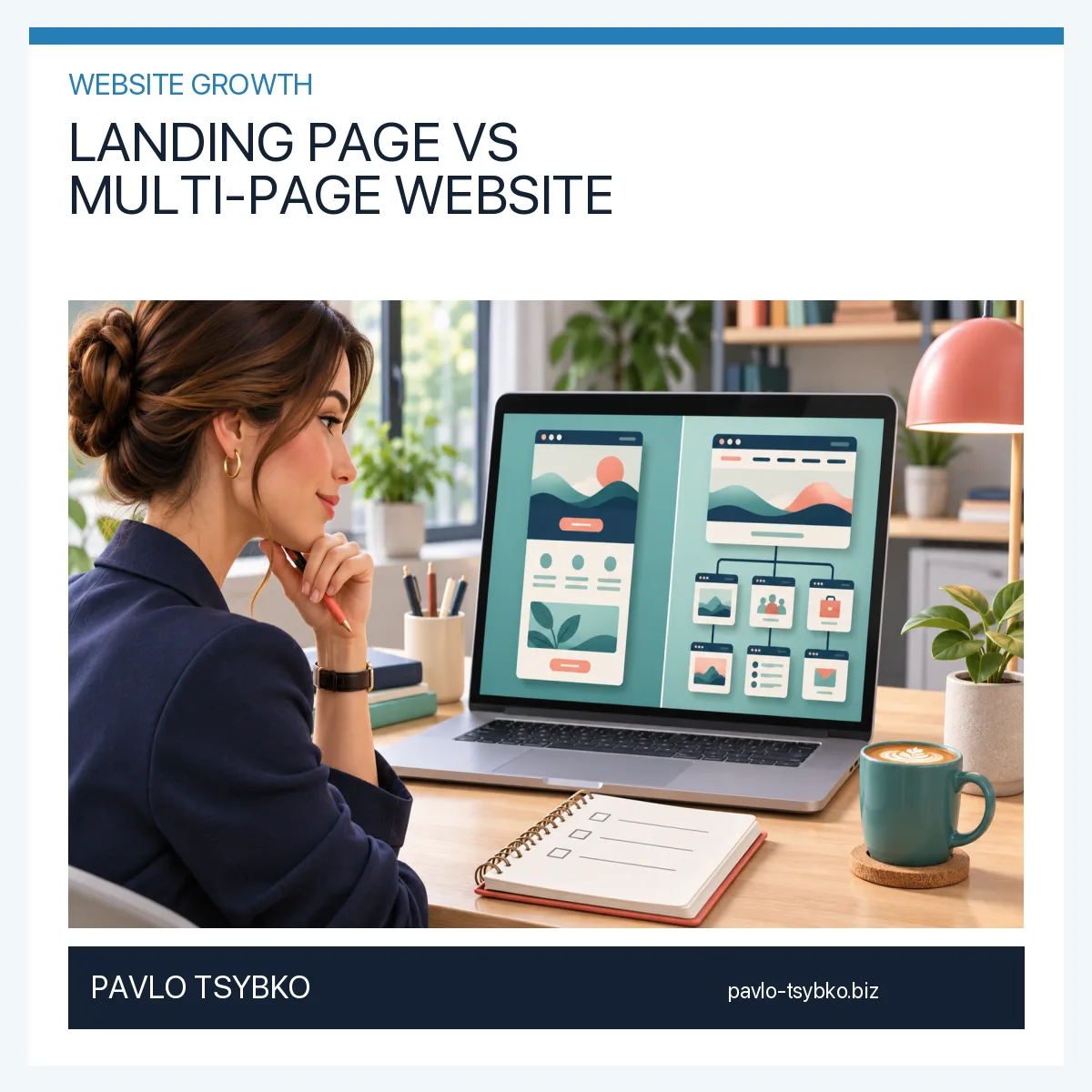
A landing page is a focused destination for a specific audience, campaign or offer. It may sit on its own or inside a larger website. It typically gives a visitor the essentials in one flow: the offer, who it is for, evidence, practical details and one clear next step.
A multi-page website uses separate pages for distinct services, products, locations, resources and company information. It can give people different paths through the business while keeping each page focused. A multi-page site can still contain dedicated landing pages for campaigns.
| Question | Landing page may fit | Multi-page site may fit |
|---|---|---|
| How many offers? | One clear offer or test | Several distinct services, products or audiences |
| How will visitors arrive? | A specific campaign, email or referral | Many discovery paths and informational searches |
| What must they compare? | A short decision with limited choices | Categories, locations, specifications or case material |
| Who maintains it? | A small team can update one focused page | Someone can maintain navigation and several useful pages |
Choose a landing page when focus matters most
A landing page is useful when you are testing one offer, sending people from a clearly defined campaign, or asking for a single action such as a booking. The page should answer objections without forcing visitors through unnecessary steps. It can include a concise headline, clear offer, evidence you can substantiate, important terms and a form or contact route. The exact number of sections or forms is not a quality rule.
Test it on a phone and make sure the promised next step works. If you need to explain very different services or support many search intents, do not keep adding unrelated sections just to preserve a one-page format.
Choose multiple pages when the information deserves structure
A multi-page site is often better for a business with multiple services, a catalog, different locations, complex buying questions or ongoing educational content. Give each important topic a useful page, group related pages logically and make navigation clear. Internal links help visitors move between related answers. Google’s link guidance recommends descriptive internal links to help people and search engines understand pages.
Do not create many thin pages merely to target keyword variations. A multi-page structure helps only when the pages offer distinct value and someone maintains them.
What about SEO and conversion?
A landing page is not limited to “five keywords,” and a multi-page site has no guaranteed search advantage. Search visibility depends on whether the content matches real queries, whether pages are accessible and useful, and many other factors. If SEO is unfamiliar, start with our plain-language What Is SEO? guide.
Likewise, there is no universal conversion rate for either format. Measure a meaningful action—qualified inquiry, booking or purchase—against the traffic source and audience. A page that earns more clicks but poorer leads may be the worse business choice. Use the same definition and time window when comparing versions.
Budget and a practical starting decision
A landing page can reduce initial scope, but the total effort still includes research, writing, design, development, analytics and iteration. A multi-page site adds content and maintenance work, yet may prevent one overloaded page from trying to serve everyone. Ask for a scope and ownership plan rather than treating any old fixed price as current.
If you have one clear offer and a specific route for sending visitors, start with a focused page and measure what happens. If customers need to compare several offers or search for different answers, plan a small, clear multi-page structure. You can expand either approach as you learn; the formats are not mutually exclusive.
For practical planning, see our business website roadmap and website portfolio. Examples are not a promise that another business will achieve the same results.